
Narrow Bedroom Makeover: 9 Weekend Projects That Actually Fit a Skinny Room
Yes — you can completely make over a narrow bedroom in a single weekend. Not a “someday” renovation, and not a shopping spree disguised as a plan: nine beginner-friendly projects, each with a realistic time estimate, that take a skinny, tunnel-like bedroom from awkward to intentional between Saturday morning and Sunday evening.
The trick isn’t working faster. It’s working in the right order and choosing projects that fight the room’s actual problem — its proportions. Every project below is picked specifically for narrow rooms: paint that breaks the tunnel effect, layouts tested before you lift anything heavy, lighting that lives on walls instead of surfaces, and builds sized for tight clearances.
Total active time for all nine projects: roughly 16 hours across two days, with drying and thinking time built in. Total cost: $150–$400 depending on what you already own. Here’s the order that makes it work.
The 2-Day Game Plan: Do It in This Order
Weekend makeovers fail for one boring reason: people decorate around clutter and commit to a layout before testing it. This order prevents both mistakes.
| When | Project | Time |
|---|---|---|
| Saturday 8:00 AM | Empty the room and tape-test a new layout | 2 hours |
| Saturday 10:30 AM | Paint the far wall to break the tunnel | 4 hours |
| Saturday 3:00 PM | Hang curtains ceiling-high and extra-wide | 90 minutes |
| Saturday 5:00 PM | Move lighting to the walls — no electrician | 2 hours |
| Sunday 9:00 AM | Build a simple plank headboard | 3 hours |
| Sunday 12:30 PM | Wallpaper the ceiling (the fifth wall) | 2.5 hours |
| Sunday 3:30 PM | The ruthless 2-hour declutter reset | 2 hours |
| Sunday 5:30 PM | Restyle the bed like a boutique hotel | 1 hour |
| Sunday 6:30 PM | Hang one oversized piece and call it done | 45 minutes |
Heavy, messy, and decision-heavy work goes first; pretty finishing work goes last. Paint before curtains, curtains before lighting, and the declutter happens after the dusty projects so you’re only sorting once. If you’ve done a full-room transformation before, you’ll recognize the rhythm from these bedroom makeover ideas — the sequence matters more than the shopping list.
Project 1: Saturday 8 AM — Empty the Room and Tape-Test a New Bed Layout

Time: 2 hours | Cost: $5 (painter’s tape)
Before you buy or build anything, pull every movable piece out of the room and outline your planned layout on the bare floor with painter’s tape. Mark the bed footprint, the dresser, and — this is the part everyone skips — the walking path from the door to the bed. Live with the tape for an hour while you have coffee.
In narrow bedrooms the winning layout is almost always the bed against the far short wall, headboard on the short end, which turns the “tunnel” into a destination. But tape lets you test the alternative — bed along the long wall with one clear walkway — without throwing your back out. The rule that decides it: you need at least 24 inches of clear walking space on one side of the bed. Whichever layout gives you that with the least furniture Tetris wins.
Weekend tip: photograph each taped layout from the doorway. The camera shows proportion problems your eyes forgive in person. For more layout-first thinking, these small bedroom ideas are built around floor plans where every square foot has to earn its keep.
Project 2: Saturday Mid-Morning — Paint the Far Wall to Break the Tunnel
Time: 4 hours (including drying between coats) | Cost: $40–$60
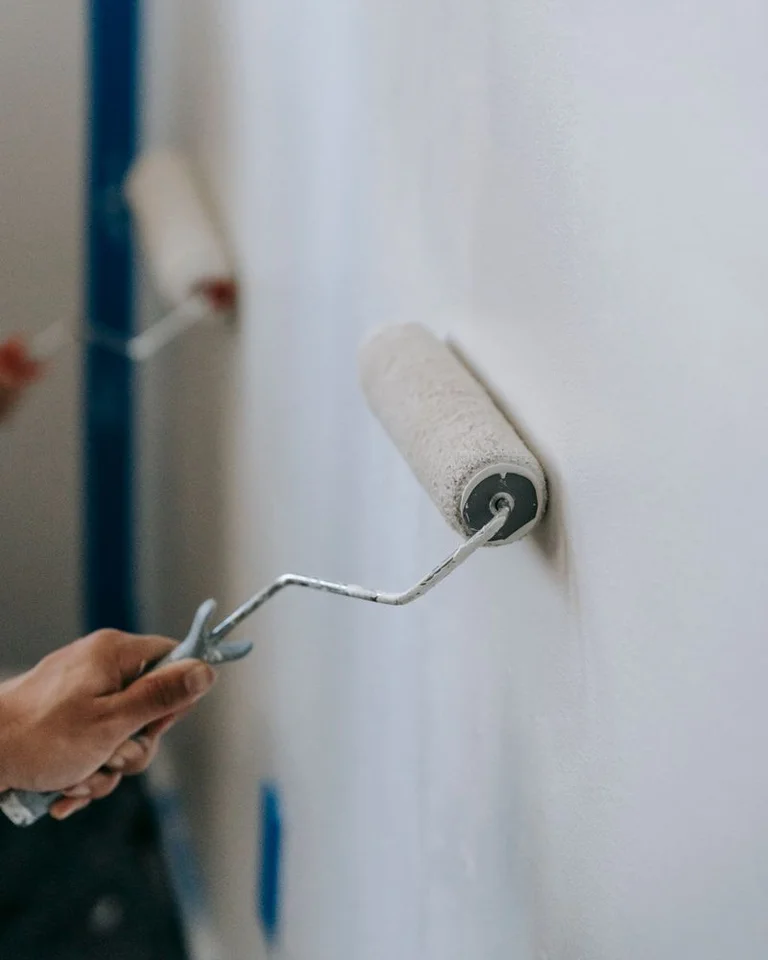
This is the highest-impact four hours of your weekend. In a narrow bedroom, paint the far short wall — the one you see from the doorway — a deeper, saturated color, and keep the long walls light. The dark end wall visually advances toward you, which shortens the perceived tunnel; the light long walls recede. It’s the oldest designer trick for bowling-alley rooms, and it works in one Saturday.
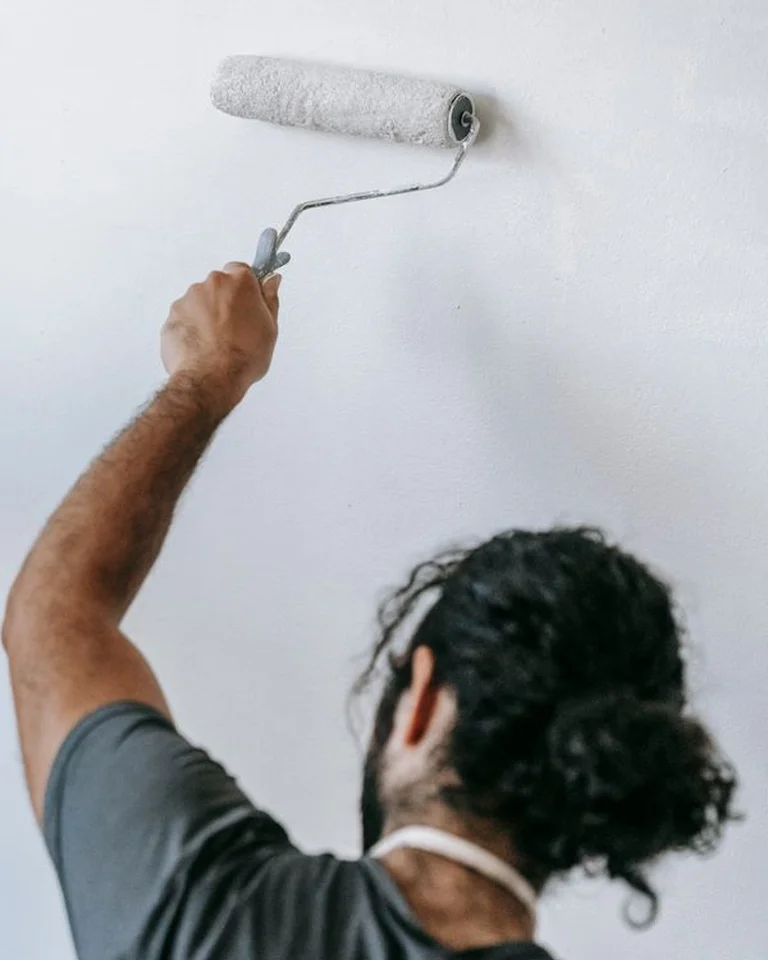
Pick a color with the bed in mind, not the paint chip: sage green, warm terracotta, dusty navy, or deep mushroom all flatter bedding and wood tones. One gallon covers a single accent wall with two coats. Cut in the edges with a brush, roll the field, and start your second coat the moment the first is dry to the touch — in a small room you’ll finish both coats before lunch.
Weekend tip: paint the wall behind where the headboard will go, even if the headboard covers most of it. The color framing the bed is what the eye registers. If sage green is calling to you, these sage green bedroom ideas show how far one color can carry a room.
Project 3: Saturday Afternoon — Hang Curtains Ceiling-High and Extra-Wide
Time: 90 minutes | Cost: $30–$70 (rod + panels)
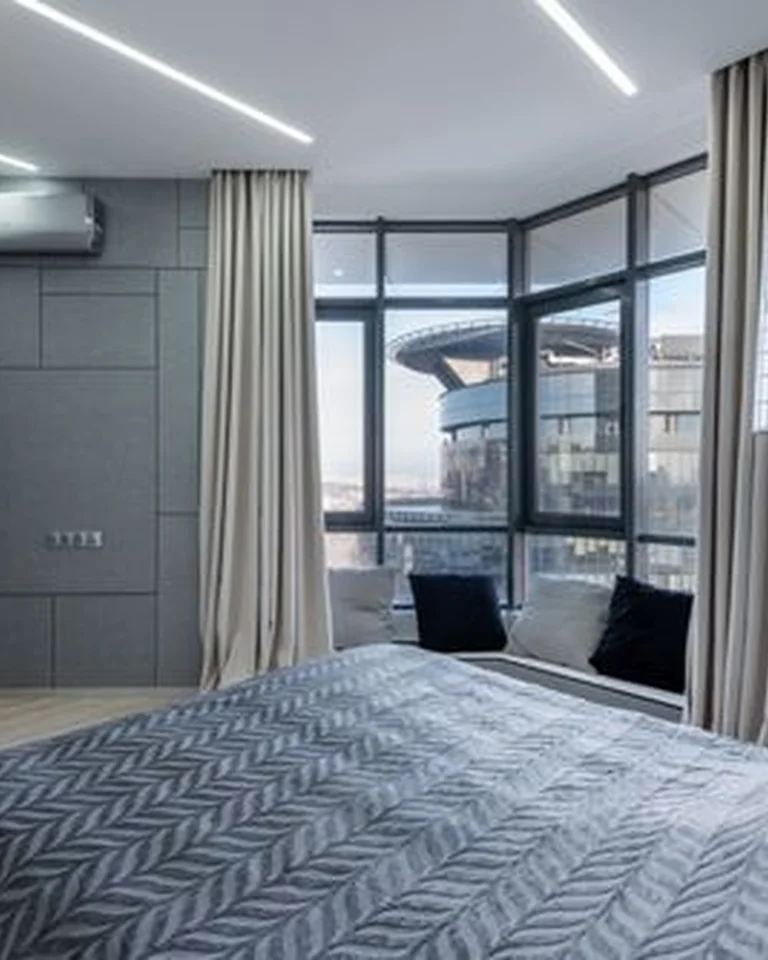
Most narrow bedrooms have one window, and most people hang the curtain rod exactly where the window trim ends — which chops the wall and makes the ceiling feel lower. The weekend fix is pure installation math: mount the rod 2 to 3 inches below the ceiling and extend it 8 to 12 inches beyond the window frame on each side.
The taller mount draws the eye up the full wall height; the wider rod lets the panels stack completely off the glass when open, so the window reads much larger and daylight floods in. In a narrow room, daylight is free square footage. Use a rod with a center support bracket if it spans more than 48 inches, and hang the panels so they just kiss the floor — fabric pooling in a tight room is a tripping hazard.
Weekend tip: this is a two-person job for exactly ten minutes (holding the rod level while you mark bracket holes). Do it solo with a laser level or a long piece of painter’s tape as your level line, and it still takes under two hours.
Project 4: Saturday Late Afternoon — Move Lighting to the Walls, No Electrician Needed
Time: 2 hours | Cost: $50–$120
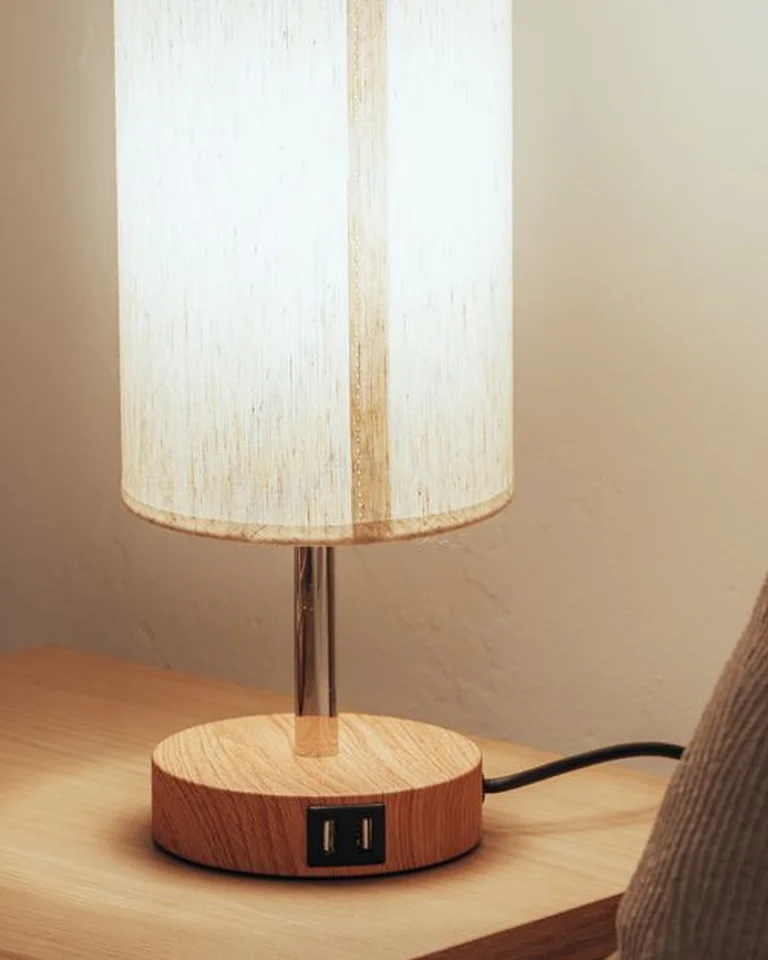
Table lamps eat the scarcest surface in a narrow bedroom: the bedside. This project replaces them with plug-in wall sconces or hanging pendants on either side of the bed — zero wiring, zero electrician, one Saturday afternoon.
Mount plug-in sconces so the shade sits about 20 inches above the mattress: high enough to read by, low enough not to glare. Run the cords straight down behind the bed and hide them with paintable cord covers, which cost a few dollars and disappear against the wall. If your ceiling is high enough, a pair of plug-in pendants hung at staggered heights does the same job and adds a sculptural moment the room probably lacks.
While you’re at it, swap every bulb in the room for warm-white (2700K) LEDs at the brightest safe wattage. Narrow rooms photographed for real-estate listings look bigger largely because they’re bright — one dim ceiling fixture is doing most of the visual shrinking.
Weekend tip: buy sconces with an on/off switch on the cord or a remote. Reaching behind the bed to fumble for a tiny switch gets old by Tuesday.
Project 5: Sunday Morning — Build a Simple Plank Headboard

Time: 3 hours | Cost: $40–$80
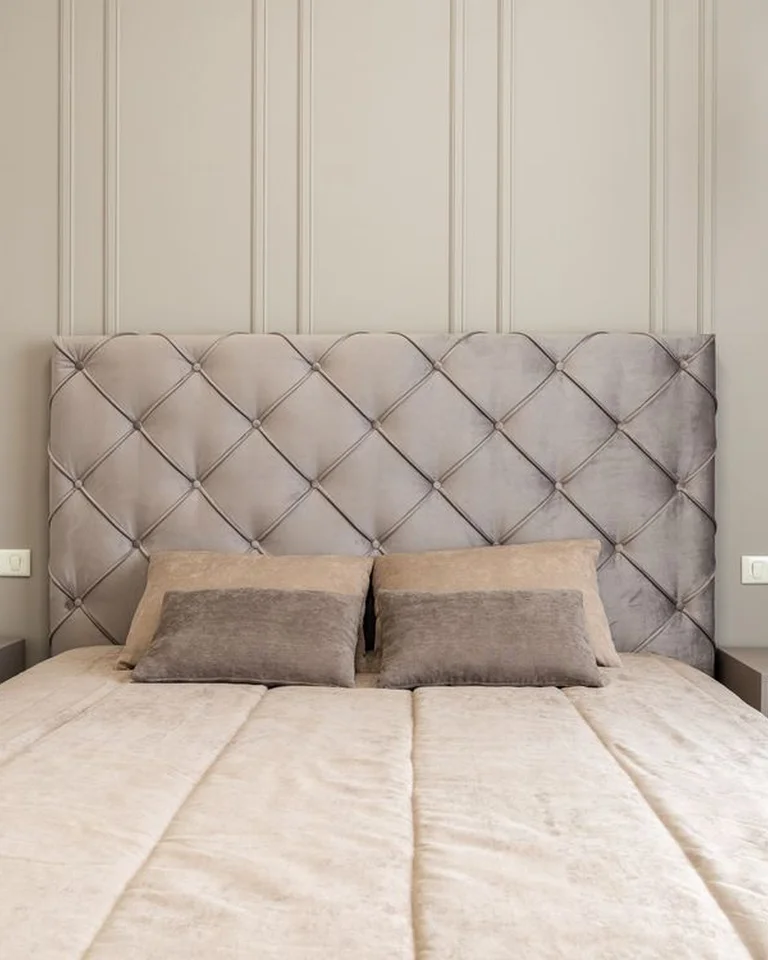
A headboard that spans the width of the bed does something crucial in a narrow room: it emphasizes the room’s one generous horizontal dimension and gives the far wall a finished focal point. A plank headboard is the fastest version a beginner can build — straight cuts, no upholstery, no joinery.
Buy five or six 1×6 pine boards cut to your bed’s width at the lumber yard (most stores cut for free), plus two horizontal backer boards. Lay the planks face-down, screw the backers across them with 1¼-inch wood screws, sand the front lightly with 120-grit, and finish with a single coat of matte polyurethane or a wash of the same paint you used on the accent wall. Mount it to the wall with a French cleat or simply wedge it between the bed frame and the wall — in a narrow room, it isn’t going anywhere.
Weekend tip: keep the headboard top at 48 to 54 inches from the floor. Taller reads grand in a normal room; in a narrow one it crowds the ceiling line and makes the tunnel feel taller and thinner — the opposite of what you want.
Project 6: Sunday Midday — Wallpaper the Ceiling, the Fifth Wall

Time: 2.5 hours | Cost: $30–$60 (peel-and-stick)
Nobody looks at a narrow bedroom’s ceiling — which is exactly why wallpapering it is such a good weekend project. A subtle pattern overhead draws the eye up and outward, breaking the tunnel gaze that runs wall-to-wall at eye level. Because ceilings in small bedrooms are, well, small, you need only two to three rolls of peel-and-stick paper.
Work in pairs: one person on the step stool smoothing, one feeding the roll. Start at the least visible corner so your learning-curve seams hide. Choose a small-scale pattern in light tones — a delicate botanical or tone-on-tone stripe — because a bold ceiling pattern in a narrow room can feel like it’s pressing down. Peel-and-stick is fully renter-friendly, which matters since so many narrow bedrooms are rentals.
Weekend tip: run a strip of painter’s tape along the wall-ceiling joint first and paper to the tape line. It gives you a clean edge without precision cutting while you’re learning.
Project 7: Sunday Afternoon — The Ruthless 2-Hour Declutter Reset
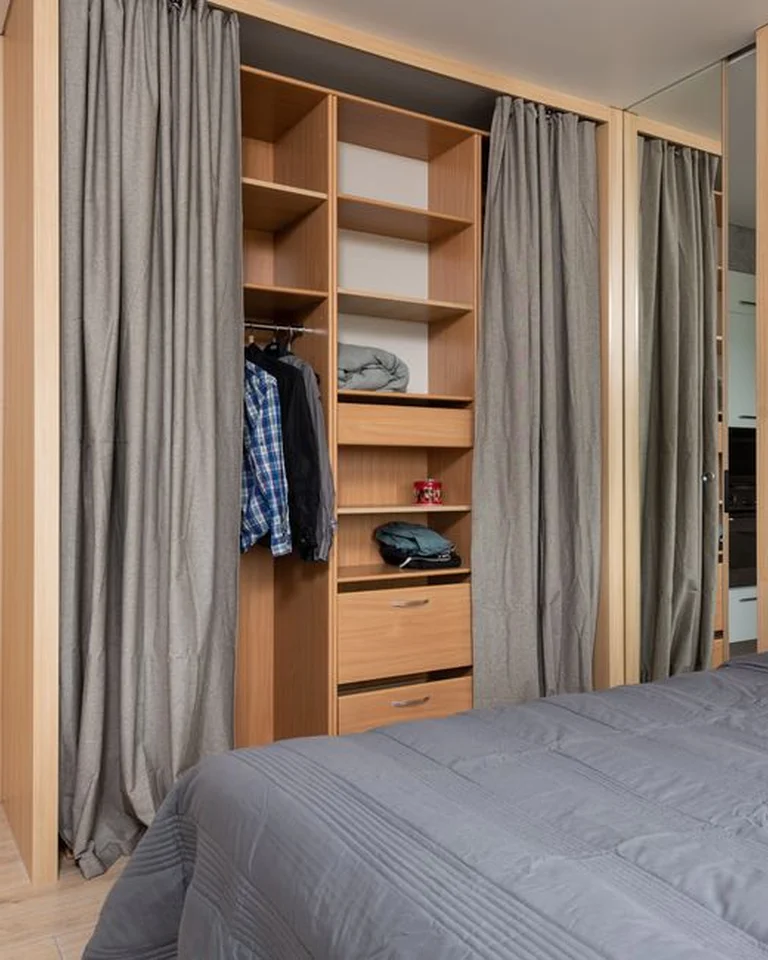
Time: 2 hours | Cost: $0
A narrow bedroom can’t hide clutter — there’s nowhere for the eye to rest away from it. Set a timer for two hours and do a single pass: everything that doesn’t belong in a bedroom leaves the room, everything broken or unused goes in a donation bag, and every surface gets cleared completely before anything is allowed back.
The rule that makes this stick: every item you return needs a closed home — a drawer, a box, a hook. Open piles are what make narrow rooms feel chaotic, because the room is small enough that you see all of them at once. Under the bed is prime real estate here; flat bins or drawers turn dead space into the room’s biggest storage zone. These small bedroom storage ideas that hide clutter and under-bed storage ideas are worth a look before you buy a single organizer — most narrow rooms need fewer containers than their owners think.
Weekend tip: declutter the closet first, not last. A narrow bedroom’s closet is usually its only real storage, and an organized closet absorbs the overflow that would otherwise live on the floor.
Project 8: Sunday Late Afternoon — Restyle the Bed Like a Boutique Hotel

Time: 1 hour | Cost: $40–$100 (if buying fresh linens)
In a narrow bedroom, the bed is 60 percent of what you see — it’s the room’s largest surface and its de facto focal point. Restyling it is the fastest visual payoff left in your weekend, and it’s pure technique, not shopping.
The formula: crisp white or ivory sheets, a duvet one size up from the bed (a queen duvet on a full bed drapes like a hotel’s), a textured throw folded across the bottom third, and pillows stacked sleeping-pillows-behind, accent-cushions-in-front. Karate-chop the accent cushions if you must — the dent reads as “styled” from the doorway. Pull the whole bed 2 inches off the wall so the linens don’t look wedged in, which is the detail that separates “made bed” from “styled bed” in tight rooms.
Weekend tip: if you buy one thing for this project, make it the throw. Texture — knit, waffle, quilted — is what keeps an all-neutral bed from reading flat, and it’s the cheapest layer with the biggest visual return.
Project 9: Sunday Evening — Hang One Oversized Piece and Call It Done

Time: 45 minutes | Cost: $20–$80
Small rooms tempt people into small art, which just emphasizes how little wall there is. Do the opposite: one oversized piece — two-thirds the width of the bed or larger — hung on the long wall or above the headboard. A single large canvas, a thrifted frame with a bold print, or even a peel-and-stick mural panel reads as confidence, and confidence is what makes narrow rooms feel designed rather than tolerated.
Hang the center of the piece at 57 inches from the floor (gallery standard) or 6 to 8 inches above the headboard. One nail, one level check, done. Then stop. The discipline of a weekend makeover is knowing which wall to leave alone — a narrow bedroom with one strong art moment and calm everywhere else feels curated; the same room with art on every wall feels busy.
Weekend tip: photograph the finished room from the doorway before you call it done. If anything in the photo bugs you, fix that one thing now — you’re still in project mode, and Monday-you won’t.
What a Narrow Bedroom Weekend Makeover Costs
Here’s an honest budget for all nine projects, assuming you own basic tools (drill, level, step stool) and buy everything else new:
| Project | Typical cost |
|---|---|
| Tape-test layout | $5 |
| Accent wall paint | $40–$60 |
| Curtain rod + panels | $30–$70 |
| Plug-in sconces or pendants (pair) | $50–$120 |
| Plank headboard lumber + finish | $40–$80 |
| Peel-and-stick ceiling wallpaper | $30–$60 |
| Declutter reset | $0 |
| Bedding refresh | $40–$100 |
| Oversized art | $20–$80 |
| Total | $255–$575 |
The thrifty version — paint, tape, curtains from a discount store, a DIY headboard from pallet wood, thrifted art, and bedding you already own — lands under $150. The projects are also fully modular: paint + curtains + lighting alone (about $120 and one Saturday) deliver maybe 70 percent of the transformation.
Mistakes That Waste Your Weekend

Painting before testing the layout. If the bed moves to a different wall after you’ve painted the “accent” wall, your focal point is now behind the dresser. Tape first, paint second — always.
Buying storage before decluttering. Narrow bedrooms don’t need more organizers; they need fewer things. Sort first, then buy exactly the bins the survivors require — usually half what you expected.
Choosing a queen bed the room can’t hold. The tape test from Project 1 exists to prevent this. A full bed with 30 inches of walkway always looks bigger than a queen with 12.
Lighting the room with a single ceiling fixture. One overhead light flattens a narrow room into a corridor. The sconce-and-pendant swap in Project 4 is the fix, and it’s the project people skip most often — don’t.
Decorating every wall. Narrow rooms need visual rest. One accent wall, one art moment, calm everywhere else. If you’re unsure whether a wall needs something, it doesn’t.
Frequently Asked Questions
Can you really redo a narrow bedroom in a single weekend?
Yes, if you define “redo” as paint, layout, lighting, window treatment, headboard, bedding, and styling — everything cosmetic. What doesn’t fit in a weekend: new flooring, moving electrical boxes, or replacing the closet system. The nine projects above are sequenced so drying time and decision fatigue never stall you, which is where most weekend makeovers actually die.
How much does a narrow bedroom makeover cost?
Between $150 and $575 for all nine projects, depending on how much you thrift and what you already own. The three highest-impact projects — painting the far wall, raising the curtains, and swapping to wall-mounted lighting — cost roughly $120 combined and can be done in a single Saturday.
What is the cheapest way to make a narrow bedroom look bigger?
Declutter ruthlessly (free), paint the far short wall a deeper color while keeping long walls light ($40–$60), and hang the curtain rod near the ceiling and wider than the window ($30–$70). Those three moves change the room’s perceived proportions without touching the floor plan.
What color should I paint a narrow bedroom?
Keep the long walls light and warm-white so they recede, and put a deeper, saturated color on the far short wall to pull it visually closer — sage green, dusty navy, warm terracotta, or deep mushroom all work. Avoid painting all four walls a dark color; in a narrow room it closes the walls in rather than adding depth.
Where should the bed go in a narrow bedroom?
Usually against the far short wall with the headboard on the short end, which turns the tunnel into a destination and leaves one clear walkway. But test it first: outline both options in painter’s tape and keep the layout that leaves at least 24 inches of clear walking space. The best answer is the one your specific room’s door swing and window allow.
A narrow bedroom doesn’t need more space — it needs a weekend of decisions made in the right order. Tape the layout Saturday morning, paint the tunnel away by lunch, and by Sunday evening the skinniest room in the house is the one that finally feels finished. For the small rooms beyond the bedroom, keep the momentum going with small bedroom ideas that make a tiny room feel bigger.