
12 No-Closet Bedroom Storage Ideas That Don’t Eat Your Room
If your bedroom has no closet, the floor quietly becomes the storage plan — the chair-drobe, the leaning tower of folded jeans, the shoes migrating under the bed. The fix is not a bigger room. It is storage that does a closet’s job without taking over the way a second closet would. Every idea below is judged on one test: does it hold a real wardrobe’s worth of clothes while leaving the room breathable?
The short answer: start with one piece that replaces the closet itself — a freestanding wardrobe or a sturdy garment rack — then layer in hidden volume (under-bed bins, a storage bench, a trunk), vertical storage (a shelving tower, wall-mounted rails, hooks), and door-back organizers. Used together, these 12 solutions hold a full wardrobe without eating the room.
One note before you start: this is a storage guide, not a decor guide. Every idea here earns its place by holding clothes, shoes, or accessories — function first. If you want the pieces that make a closet-less bedroom look finished, that is a different article; this one is about where everything actually goes.
1. A Freestanding Wardrobe — the Closest Thing to a Real Closet

A freestanding wardrobe is the only single purchase that fully replaces a closet: hanging space up top, shelves below, doors that close. That last part matters more than people admit. In a bedroom without a closet, everything you own is potentially on display, and doors are what keep a full wardrobe from reading as clutter. Choose a wardrobe with a real hanging rod (not just shelves), 60 inches of interior height for long items or a double-hang section for shirts, and a depth of at least 20 inches so hangers sit straight instead of angled.
Measure twice before you buy. Wardrobes are the bulkiest piece on this list, and a 40-inch-wide unit in a 10-foot room eats a real share of the wall. The trick is to treat it as the room’s one anchor piece and let everything else stay slim and low. If you want it to feel built-in rather than borrowed, see our modern farmhouse bedroom storage ideas for how solid-wood pieces settle into a room’s style instead of fighting it.
2. An Open Garment Rack That Behaves Like Furniture
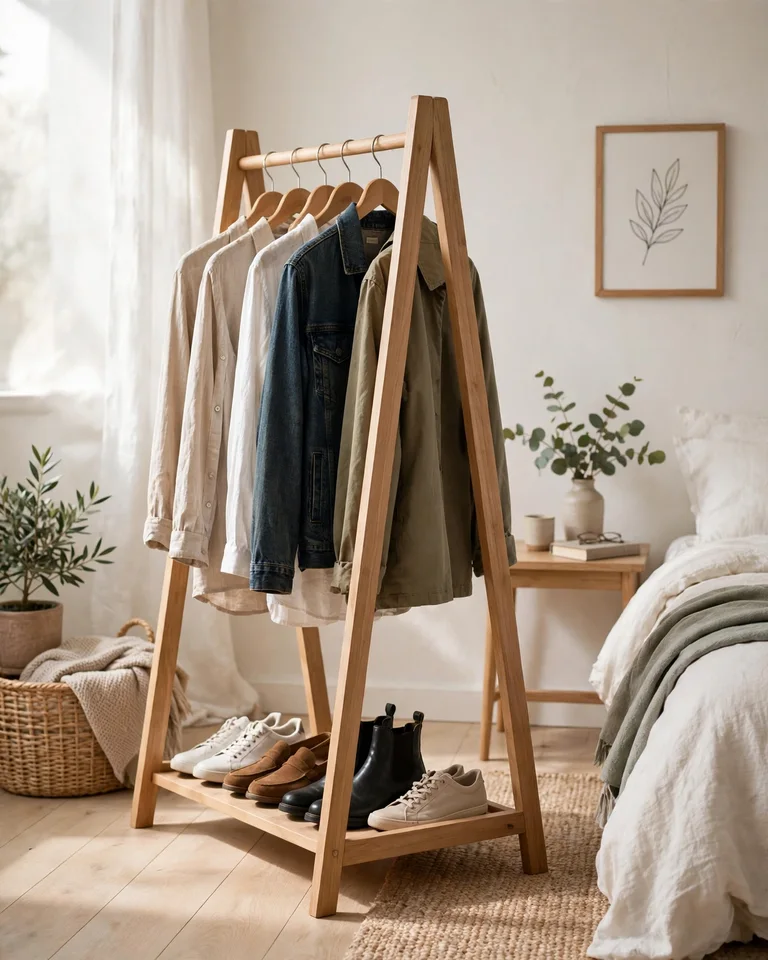
When a wardrobe is too big, too expensive, or too permanent for a rental, a garment rack is the honest alternative — one rail, zero doors, about 18 inches of floor depth. The difference between a rack that looks intentional and one that looks like a dorm room is entirely in the editing: matching slim hangers, a curated rotation of what you actually wear this season, and nothing crammed. A rack holding 20 well-spaced garments looks like a boutique; the same rack holding 45 looks like a laundry pile with ambition.
Buy for stability, not just style. Cheap single-rail racks bow under a winter wardrobe, so look for a steel frame rated for at least 100 pounds, or an A-frame wood design that cannot tip sideways. Park it against a wall you do not walk past — every brush against an open rack transfers wrinkles — and put a low shoe shelf or two storage boxes underneath so the floor beneath it works too.
3. Under-Bed Bins and Drawers — the Biggest Hidden Volume in the Room

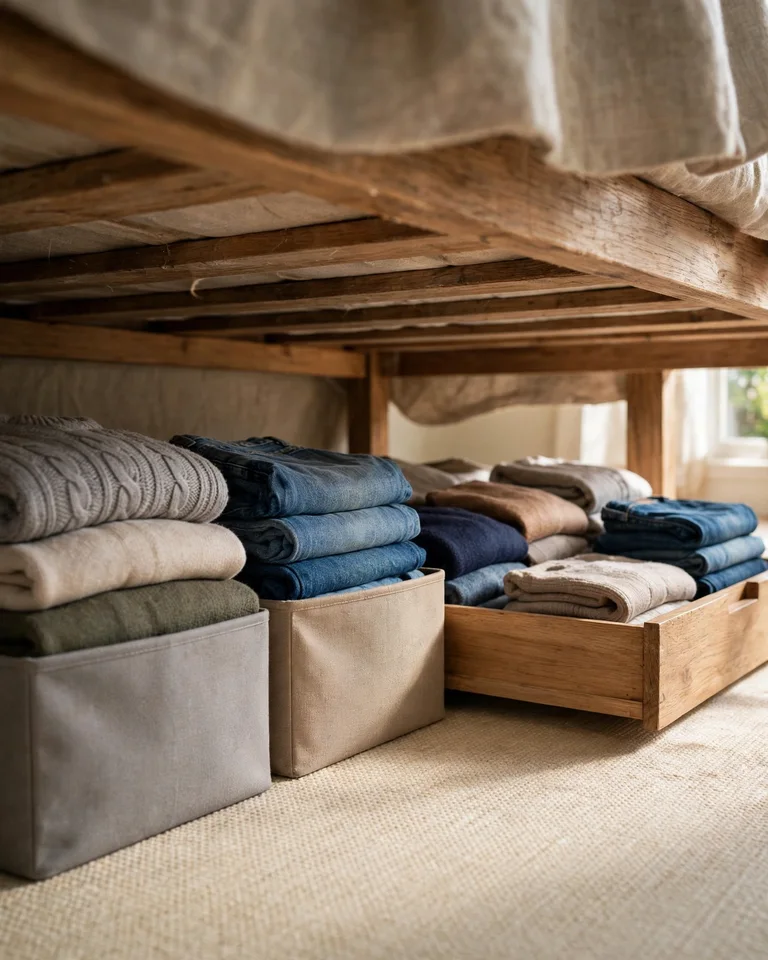
A standard queen bed hides roughly 25 to 30 cubic feet of storage underneath — more uninterrupted volume than any dresser you will ever buy — and it costs zero floor space because the footprint was already spent. This is where off-season clothes, spare bedding, and the sweaters you wear four months a year should live. Low-profile bins with lids (about 6 to 7 inches tall) slide under most frames; measure your clearance first, because platform beds and divan bases vary wildly.
The container matters as much as the space. Lidded bins keep dust out and stack neatly; open fabric cubes collect dust and sag. Label each bin by category — “winter knits,” “guest bedding” — so you are not pulling out four boxes to find one sweater. For a deeper breakdown of what fits under different bed types, our under-bed storage ideas cover bins, drawers, and platform-bed options room by room.
4. An Over-the-Door Organizer

The back of the bedroom door is square footage you already own and currently use for nothing. An over-the-door organizer — pockets, hooks, or a hanging shelf unit — turns it into storage for the small things that otherwise colonize every surface: shoes, scarves, belts, sunglasses, the handbag rotation. Clear or canvas pocket organizers are the most versatile; a 24-pocket unit holds a surprising amount without sticking out far enough to stop the door closing.
Two practical notes. First, check the door’s clearance: organizers with thick hooks can scrape the frame on doors with tight gaps, so measure the gap or choose a slim-profile hook. Second, keep the weight reasonable — a door full of boots will swing oddly and strain hinges over time. Shoes and accessories, yes; your dumbbell collection, no.
5. A Dresser or Chest of Drawers
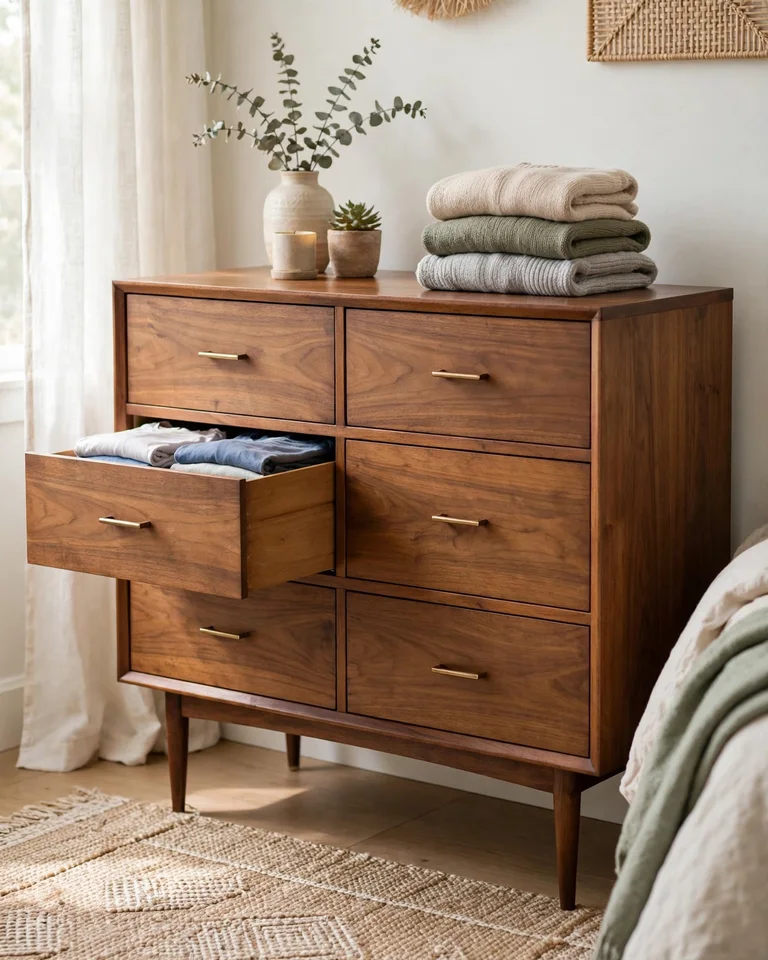
Some clothes simply should not hang — knitwear stretches on hangers, and nobody wants to iron a t-shirt. A dresser is the folded-clothes headquarters of a closet-less bedroom, and six shallow drawers beat three deep ones every time: shallow drawers let you file-fold everything vertically so every item is visible, while deep drawers become archaeological digs by week three. A standard 6-drawer dresser holds roughly what a closet’s shelf-and-drawer section would.
Placement is the strategy here. A dresser under a window uses dead wall space without blocking light; one against the wall opposite the bed doubles as a surface for the things a closet door would otherwise hide. If the top surface starts collecting clutter, that is a sign you need a small tray or basket up there to give loose items a boundary — not a bigger dresser.
6. A Tall Open Shelving Tower With Baskets

When floor space is the constraint, the only direction left is up. A tall, narrow shelving unit — 12 to 16 inches deep, 5 to 6 feet tall — stores as much as a dresser in a fraction of the footprint, because it borrows vertical wall space instead of floor. The baskets are not decoration; they are what make open shelving work for clothes. Folded stacks on open shelves slump and slide; the same clothes inside a basket stay contained and pull out like a drawer.
Anchor it to the wall — a loaded 6-foot tower is a tipping hazard, especially with kids or in earthquake-prone areas — and keep the heaviest baskets on the bottom shelves. Reserve the top shelf for the things you touch monthly, not daily, so you are not climbing for socks. Vertical storage is also the move when headroom is tight: our low-ceiling bedroom storage ideas use the same go-up-not-out principle to keep floor space clear.
7. A Storage Bench at the Foot of the Bed
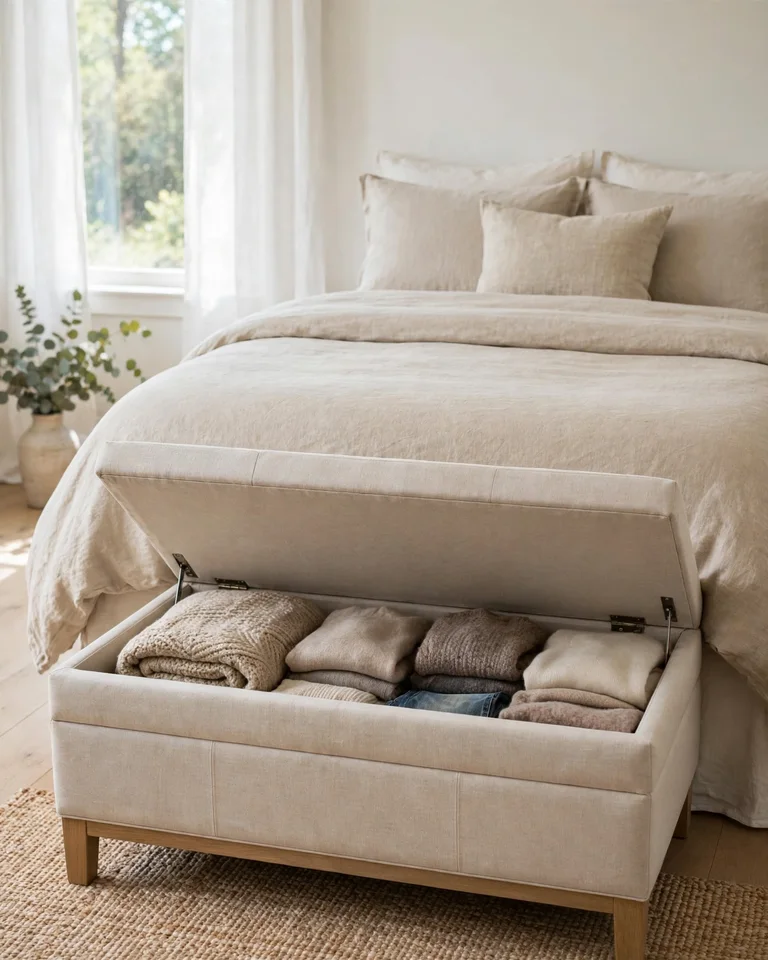
A storage bench is the hardest-working seat in a closet-less bedroom: somewhere to sit while putting on shoes, plus a full hidden compartment for bulky items. Off-season coats, spare blankets, the duvet you swap in November — the things that are too big for drawers and too ugly for open shelves — all disappear into a bench. Look for a hinged lid that stays open on its own (a lid that slams on your fingers gets used exactly once) and an interior at least 12 inches deep.
Keep it lower than the top of the mattress so the bed-to-bench line stays clean, and choose a length about two-thirds the bed’s width so it does not crowd the walkway. Upholstered tops in tightly woven fabric handle daily sitting; woven or wicker looks better but offers less usable interior space for the same footprint.
8. A Wall-Mounted Hook Rail

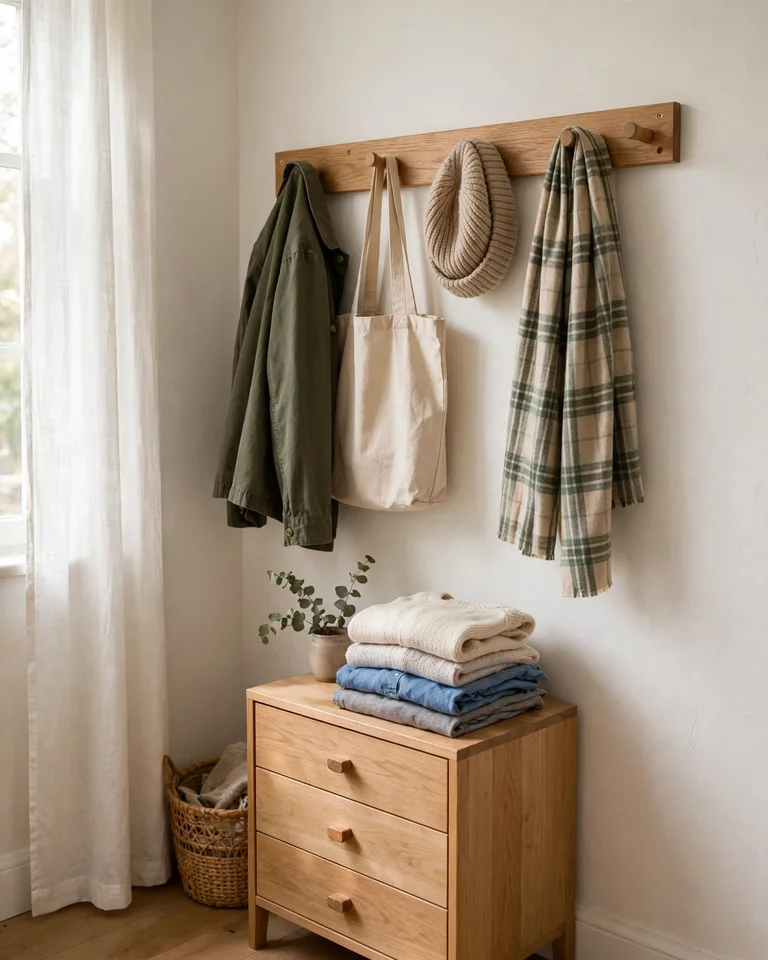
Not everything needs a hanger, a drawer, or a bin. Jackets, robes, tomorrow’s outfit, the tote bag you grab daily — these are “in transit” items, and a hook rail gives them a home between the closet-that-isn’t and the chair. A 4-to-6 hook rail mounted at 60 to 66 inches high (about shoulder height) handles the daily rotation for one person; mount it inside the wardrobe if you have one, or on the wall by the door where you dress and undress.
This is the cheapest idea on the list and the one renters should do first: adhesive or single-screw hook rails install in minutes and remove cleanly. For heavier-duty versions and creative rail placements through the whole house, our pegboard ideas for every room cover the same grab-and-go logic in more detail. The rule that keeps hooks working: one hook, one item. The moment hooks start doubling up, they become the new chair-drobe.
9. A Rolling Storage Cart
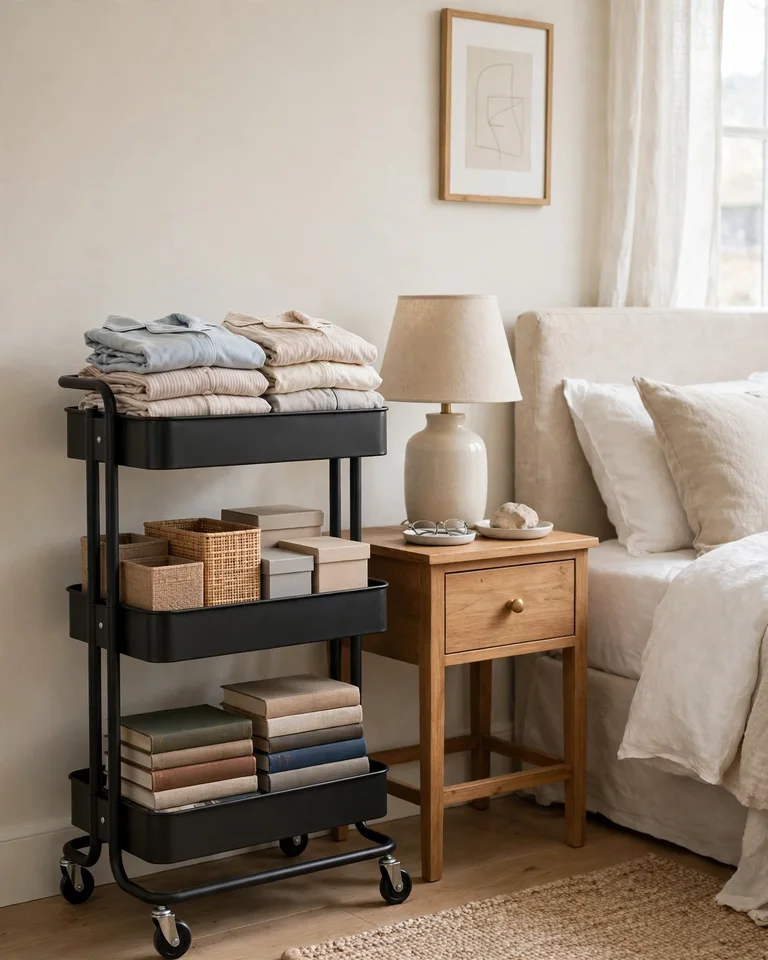
A three-tier rolling cart is the only storage on this list that moves. That sounds trivial until your bedroom has to be a dressing room, a laundry staging area, and a sleeping space in the same 120 square feet. Roll it to the bed for folding laundry, tuck it into the wardrobe alcove when guests come, park it beside the rack as a shoe and accessory station. The 15-by-22-inch footprint fits gaps nothing else can use — between the bed and the wall, at the end of a hallway, inside a wide wardrobe.
Choose one with locking casters (a cart that drifts across the room at 2 a.m. is a hazard, not a helper) and a handle on one end. Metal utility carts wipe clean and hold real weight; fabric or plastic versions are lighter but sag under books and boots. Dedicate each tier to one category — pajamas and loungewear, accessories, current projects — so the cart stays a system instead of becoming a junk drawer on wheels.
10. A Wall-Mounted Double-Hang Rail

If you can put screws in the wall, a wall-mounted rail beats a freestanding rack on every measure that matters in a small room: zero floor footprint, no wobble, and you choose the exact height and length. The double-hang version — two parallel rails, shirts up top and shorter items below — nearly doubles hanging capacity in the same wall span as a single rod. A 4-foot double rail holds roughly 40 to 50 garments, which is a full working wardrobe for most people.
Mount into studs, not just drywall — 40 garments plus the rail itself is real weight, and a rail that pulls out of the wall at midnight is a story you will tell for years. Leave 40 inches of vertical space per hanging level for shirts and 60 for dresses, and mount a shelf above the top rail for folded knitwear to complete the closet-wall effect.
11. A Lidded Trunk or Storage Chest

Before closets were standard, the trunk was the closet — and it still works. A lidded chest at the foot of the bed or against a wall swallows the bulky, seasonal, and sentimental: winter coats, memory boxes, the quilt collection. Unlike under-bed bins, a trunk’s contents are accessible without kneeling and dragging, and unlike open shelving, everything inside is dust-free and invisible. Cedar-lined chests add moth protection for wool and cashmere, which is a genuine functional upgrade, not a marketing line.
Size it to the room, not the fantasy: a 36-to-40-inch trunk fits the foot of a queen bed without blocking walkways, and anything deeper than 20 inches becomes hard to reach into. Flat lids double as a surface — a tray on top turns it into a nightstand-adjacent landing zone — while domed lids look romantic and hold nothing. If the trunk will store anything you wear, add a sachet of lavender or cedar blocks; trunks seal tightly, and sealed plus dark plus undisturbed is exactly what moths like.
12. Cube Storage With Fabric Bins
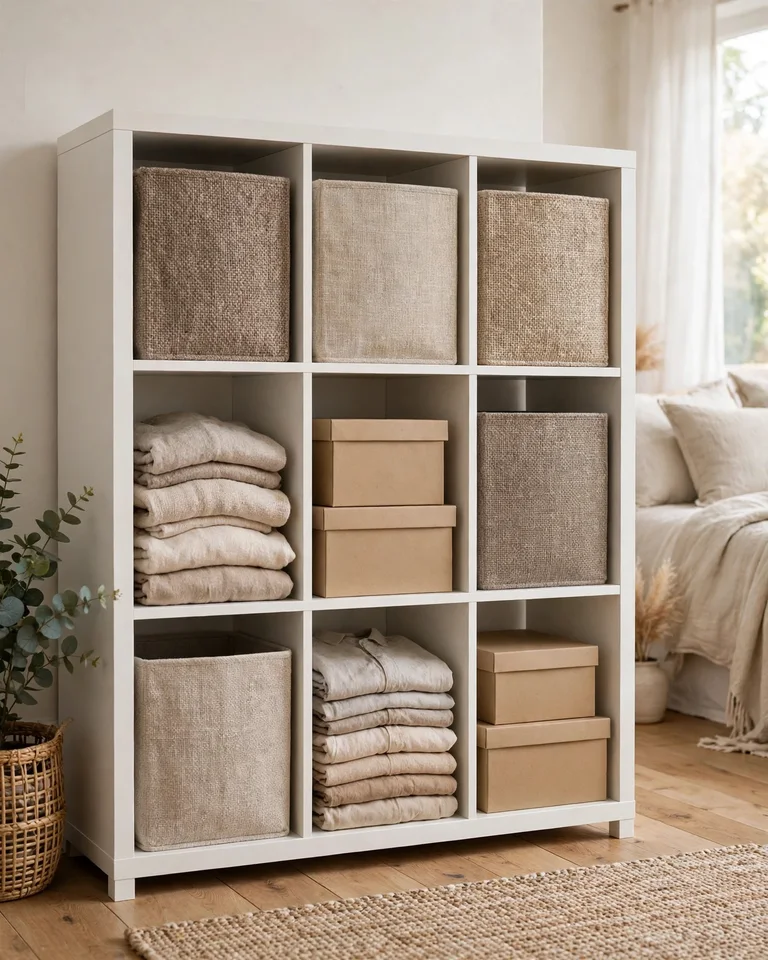
Cube storage is the modular answer to “I don’t know what I need yet.” A 2×4 or 3×3 cube unit with fabric bins gives you a dozen compartments you can assign by category — one cube per person in a shared room, one per clothing type, one per season — and rearrange as the wardrobe changes. The bins are the system: uniform bins in one color make an open unit look calm, and labeled bins mean anyone in the house can put laundry away correctly.
Cubes shine in shared bedrooms, where each person gets their own column and the “whose is this” problem disappears. They also stack and reconfigure, so the same unit works as a nightstand-height 2×2 today and a full wardrobe wall tomorrow. For rooms where two people’s clothes share one small space, our shared sibling bedroom storage ideas build on this same give-everything-a-zone logic. Buy the bins and the unit together — “standard” cube sizes vary by brand, and a bin that is half an inch too wide is a bin that lives on the floor.
3 Storage Mistakes That Eat Your Room

Before you buy anything, make sure you are not committing one of these three errors — each one makes a closet-less bedroom feel smaller no matter how good the storage is:
1. Buying open storage before editing the wardrobe. Open racks and open shelves only work with an edited wardrobe. If every garment you have owned since college goes on the rack, the rack becomes visual noise and the room feels chaotic. The sequence is: remove what you do not wear, then choose storage for what remains — never the reverse. Our small bedroom storage ideas start from this same edit-first principle.
2. Using the floor as a category. The chair-drobe, the floor pile by the bed, the shoes migrating under the dresser — these are not storage, they are deferred decisions, and they eat floor space while looking like clutter. Every item needs a named home: hooks for in-transit, bins for off-season, drawers for folded. If something has no home after this article, that is your shopping list.
3. Buying single-purpose pieces. In a bedroom with a closet, a decorative chair is harmless. In a bedroom without one, every piece must earn its footprint twice: a bench that stores, a trunk that serves as a table, a cart that rolls where it is needed. One single-purpose piece is fine; five is how a small room fills up with furniture and still has nowhere to put a sweater.
Frequently Asked Questions
How do you store clothes without a closet?
Combine one closet-replacement piece with hidden and vertical storage: a freestanding wardrobe or garment rack for hanging, a dresser for folded items, under-bed bins for off-season clothes, and hooks or an over-the-door organizer for daily items. Splitting clothes by type — hang what creases, fold knits, hook what is in transit — keeps the system working instead of collapsing into piles.
Where do you put clothes if your bedroom has no closet?
Clothes can go in a freestanding wardrobe or armoire, on a garment rack, in a dresser or chest of drawers, in under-bed bins, on wall-mounted rails and hooks, in a storage bench or trunk, or in cube storage with fabric bins. Over-the-door organizers handle shoes and accessories. A combination of two or three of these covers a full wardrobe; no single piece has to do everything.
How do I organize a small bedroom with no closet?
Start by editing the wardrobe down to what you actually wear, then give every category a named home: hanging space for crease-prone items, drawers for folded clothes, bins for off-season, hooks for daily rotation. Use vertical space (tall shelving, wall rails) and hidden space (under the bed, inside a bench) before adding anything that sits on the floor, and keep open storage curated with matching hangers and uniform bins so it reads as intentional.
What is the best renter-friendly way to hang clothes without a closet?
A freestanding garment rack is the fastest no-drill option — no holes, moves with you, and holds a full hanging wardrobe on a sturdy steel frame. Pair it with an over-the-door organizer for shoes and accessories and a set of slim uniform hangers. If you can use small screws, a tension-mounted rail between two walls works too, but a freestanding rack is the zero-commitment choice.
Should no-closet bedroom storage be open or closed?
Both, split by content. Closed storage — wardrobes with doors, dressers, lidded bins, trunks — goes low and holds anything unattractive: off-season clothes, spare bedding, the clutter-prone categories. Open storage — racks, rails, open shelving — works at eye level for the curated daily wardrobe, but only if what sits on it is uniform: matching hangers, consistent baskets, an edited selection. Open storage full of chaos is just clutter with better lighting.
How do I store shoes in a bedroom with no closet?
Go vertical and hidden: a slim shoe rack or the lower shelf of a garment rack for daily pairs, an over-the-door pocket organizer for flats and sandals, and lidded under-bed bins for off-season boots. Keeping daily shoes to one defined spot — a rack, a tray by the door, one shelf — stops them from migrating across the floor, which is where shoes do the most visual damage in a small room.
A bedroom without a closet is not a bedroom without storage — it is a bedroom where storage has to be chosen instead of inherited. Pick the one piece that replaces the closet, add hidden volume under the bed and inside dual-purpose furniture, and give every category a home. Do that, and the room stays a bedroom first and a wardrobe second, instead of the other way around.