
Low-Ceiling Bedroom Weekend Makeover: 7 Projects That Make the Room Feel Taller
You do not need a renovation to fix a low-ceiling bedroom — you need a weekend. With a clear sequence, about $250 in materials, and renter-friendly methods throughout, you can take a room that feels boxed-in on Friday night and make it read open, calm, and intentional by Sunday dinner. The plan below is that exact sequence: what to do in which order, how long each step takes, and what it costs.
The short answer: spend Friday evening clearing and re-planning the layout, Saturday repainting the flat white ceiling and adding one vertical peel-and-stick accent wall, and Sunday raising the curtains to ceiling height, swapping the lighting to a flush mount plus plug-in sconces, resetting the furniture layout, and finishing with a styling reset. Do it in that order and no step undoes the one before it.
The Weekend Schedule at a Glance
Before you touch a tool, tape this schedule to the door. Each block assumes a standard 10×12-foot bedroom and one person working at a normal DIY pace.
Friday evening (90 minutes): clear-out and layout reset
Saturday morning (3–4 hours): repaint the ceiling
Saturday afternoon (2–3 hours): one vertical peel-and-stick accent wall
Sunday morning (1–2 hours): re-hang curtains at ceiling height
Sunday midday (1–2 hours): lighting swap — flush mount plus plug-in sconces
Sunday afternoon (1 hour): furniture layout reset
Sunday evening (30 minutes): styling reset and walkthrough
Everything here is renter-safe: flat ceiling paint approved by most landlords (or easily repainted), truly removable wallpaper, tension or adhesive-mounted rods, and plug-in lighting. If you own the room, the same plan works — just swap renter options for their permanent equivalents where noted.
Friday Evening: The 90-Minute Clear-Out and Layout Reset

A makeover weekend fails before Saturday when it starts with clutter. Move every non-essential item out of the room — not into the closet, out of the room. Stack furniture in the center and cover it with drop sheets. You need every wall fully accessible this weekend, and you need to see the room’s actual proportions without stuff stacked against the walls.
With the room empty, do the layout planning now, not Sunday. In a low-ceiling room the rule is simple: put the bed against the longest wall and keep everything low. Any furniture that ends within 18 inches of the ceiling comes off the plan — a tall dresser against the wall in a 7.5-foot room eats vertical air you cannot spare. If a tall piece must stay, it gets the shortest wall, never the focal wall behind the bed. For more on thinking through a room’s layout before decorating it, see our narrow-bedroom guide to designing a room, not just decorating it — the same measure-first discipline applies here.
Photograph the empty room from the doorway and from each corner. These are your “before” shots; they also stop you from second-guessing the plan halfway through Saturday.
Saturday Morning: Repaint the Ceiling (The Single Biggest Win)
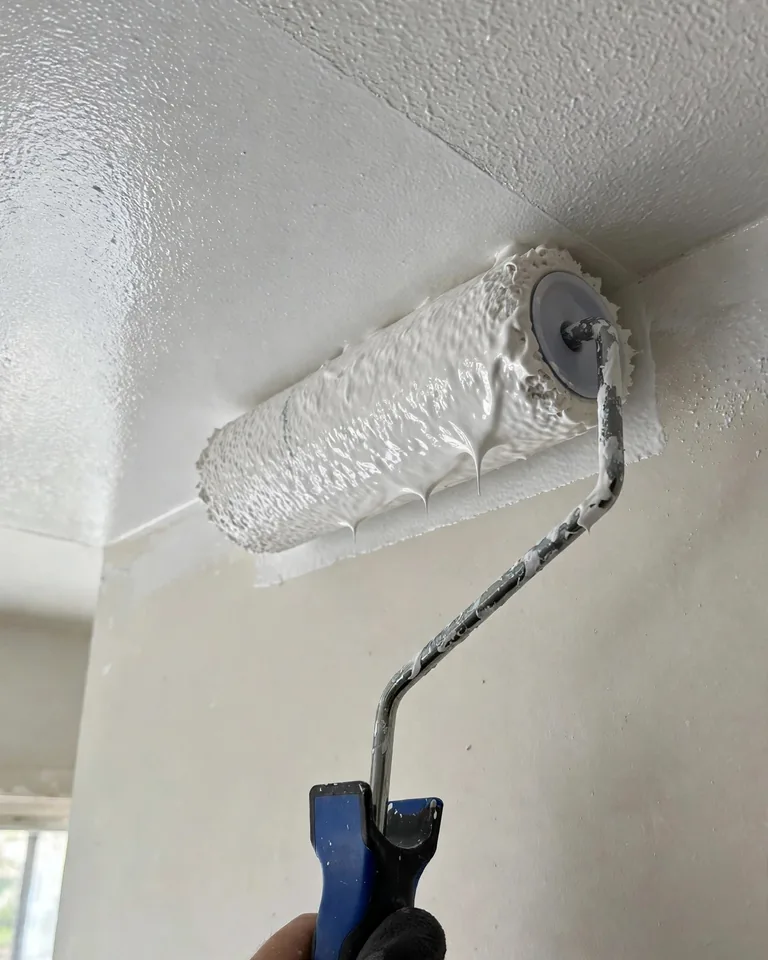
The ceiling is the biggest surface in the room and the one your eye measures most, so it gets Saturday morning — the freshest four hours of the weekend. A flat or matte white ceiling reflects the most light and erases texture shadows that make a low ceiling feel lower. Flat finish matters more than the brand: gloss and even eggshell bounce the room’s own compressed surface back at you.
What to buy: one gallon of flat white ceiling paint ($25–$40 covers a standard bedroom ceiling twice), a 9-inch roller with an extension pole, a 2-inch angled brush for cutting in, painter’s tape, and drop cloths. Cut in the edges first, then roll in long, even strokes — thin coats dry faster and flatter than one thick one. Two coats is the norm; the second goes on after the first is fully dry, which is why this job owns the whole morning.
Renter note: most leases allow white-on-white repainting, but text your landlord tonight (Friday) so there is no ambiguity. If painting is off the table, skip to the accent wall and curtains — the weekend still works, just with slightly less lift.

Saturday Afternoon: One Vertical Peel-and-Stick Accent Wall

With the ceiling done, Saturday afternoon goes to the wall behind the bed — the one the eye lands on first. Vertical stripes pull the gaze upward in one continuous motion, and because the ceiling is now fresh flat white, the top edge of the paper reads as a clean, deliberate line instead of a busy junction.
Choose a peel-and-stick paper with narrow vertical stripes in a lighter tone — one roll ($30–$80) covers a standard accent wall. Apply it to the wall behind the bed: peel, stick, and smooth from the center outward, cutting neatly at the top and bottom with a sharp utility knife. Test a small piece first on an inconspicuous spot; quality varies, and cheaper prints show more visible pattern repeats at the seams.
One wall only. Papering every wall in a low room turns the vertical trick into visual noise. The three plain walls get their turn in the styling phase — they are the calm backdrop that lets the accent wall do the lifting.

Sunday Morning: Re-Hang Your Curtains at Ceiling Height

Sunday opens with the fastest transformation of the weekend: moving the curtain rod from window height to within 2–4 inches of the ceiling line. Curtains hung at window height chop the wall into a short upper section and a longer lower one, and the eye registers the short section — the ceiling feels lower. One unbroken drop of fabric from near the ceiling to the floor reads as a single tall plane, and the window looks taller with it.
What to buy: a slim rod that extends 4–6 inches past the window frame on each side, and curtain panels 8–12 inches longer than your current ones — the fabric should kiss the floor or pool slightly. Keep it lightweight and neutral; heavy drapes on a tension rod will bow the middle over time. For renters, a sturdy tension rod or ceiling-mounted adhesive track gets the same unbroken drop with no drilling.
Hang, step back to the doorway, and check the wall: the fabric should run in one straight vertical line from top to bottom with no valance or bulky finial breaking it. That single unbroken line is the whole point of the project.
Sunday Midday: Swap the Lighting (Flush Mount + Plug-In Sconces)

Midday is lighting, because a low ceiling and a hanging pendant are a bad combination — the small gap between a dangling shade and the ceiling reads as severe compression. This is a two-part swap you can finish in under two hours with the breaker off.
Part one — the ceiling fixture: replace any pendant or semi-flush fixture with a flush-mount panel or dome that sits one to two inches thick against the ceiling. A 12- to 18-inch round panel with a frosted diffuser in warm white (2700–3500K) on a dimmer is the sweet spot: the ceiling plane stays smooth and unbroken, and dimmed to half in the evening it reads as mood lighting instead of a compromise. Most panels mount to a standard junction box with two screws.
Part two — the walls: add slim plug-in sconces flanking the bed, mounted slightly higher than the usual 60 inches from the floor. Upward-facing shades wash light toward the freshly painted ceiling, which genuinely lifts where you perceive the ceiling to begin — and they free your nightstands from bulky table lamps, keeping the bedside line low. Cord covers matched to your wall color keep renters deposit-safe. For more on layering bedroom light without overhead fixtures, our hallway lighting ideas cover the same wall-washing principles in small spaces.
Sunday Afternoon: Reset the Layout for Horizontal Calm

Now that paint, paper, curtains, and light are done, bring the furniture back in — in the new layout you planned Friday, not the old one. In a low-ceiling room, the winning composition is low and horizontal: bed centered on the longest wall, the top of the mattress well below your sightline from the doorway, slim nightstands, and a low-profile dresser on a secondary wall.
If you are buying one piece this weekend, make it a low-profile platform bed frame (floor to top of mattress around 14–18 inches). Swapping a tall bed for a low platform is the highest-impact furniture change in a low room — it opens a band of visible wall above the bed that reads as air. Skip the tall headboard; it spends vertical space you do not have. Our narrow-bedroom weekend makeover follows the same Friday-to-Sunday rhythm if you want a second room to run this exact playbook on next.
Leave clear floor around the bed — at least two feet on the sleeping side. Walking space is perceived space, and a cramped perimeter undoes the airy ceiling work in one glance.
Sunday Evening: The 30-Minute Styling Reset

The last thirty minutes are styling, not shopping. Dress the bed in one tonal family — washed linen duvet, a folded throw across the lower third, two sleeping pillows — so the room’s largest object reads as one calm mass instead of a stack of competing layers. See our white bedroom decor guide for how warm versus cool whites behave as a base.
Add exactly one tall plant (a snake plant or olive tree in a floor-sitting pot) in a corner — one deliberate vertical line that paradoxically makes the ceiling feel further away — and hang a wide horizontal mirror at eye level on a side wall, aimed at a wall or window, never at the ceiling. Then walk the room once with your “before” photos open. The difference you see in that comparison is the entire point of the weekend.

The Weekend Budget Breakdown
Every number below assumes one DIY-er, a 10×12-foot room, and US home-improvement store prices. Your total lands between roughly $175 and $320 depending on what you already own.
Saturday morning — ceiling repaint: $45–$70 (one gallon flat white ceiling paint, roller, extension pole, angled brush, tape, drop cloths)
Saturday afternoon — accent wall: $30–$80 (one roll of peel-and-stick vertical stripe wallpaper, utility knife and smoother)
Sunday morning — curtains: $40–$70 (slim rod + two lightweight floor-length panels; less if you re-hem existing panels)
Sunday midday — lighting: $50–$90 (flush-mount panel + two plug-in sconces with cord covers)
Furniture: $0 if you are working with what you own; a low platform bed frame runs $120–$200 if you buy one
The makeover math that matters: the first four line items — the ones that change how tall the room feels — total $165–$310 and are the non-negotiable core. Everything else is optional. For more room transformations built around a hard budget, our modern farmhouse bedroom makeover ideas show how far paint and layout go before you buy anything.
4 Makeover Mistakes That Waste a Weekend
1. Starting with shopping instead of the clear-out. Buying decor for a room you have not emptied and re-planned is how you end up with pieces that fight the layout. The clear-out is Friday for a reason — it is also free.
2. Painting the ceiling eggshell or semi-gloss. Sheen reflects the room’s own compressed surface. Flat or matte, always — the $5 saved on a cheaper finish costs you the entire effect.
3. Papering more than one wall. The accent wall works because the other three walls are calm. Two or four striped walls in a low room reads as a cage, and you will spend Sunday peeling off Saturday’s work.
4. Hanging the new curtains at the old height. A new rod at window height changes nothing. The 2-to-4-inches-below-the-ceiling rule is the difference between curtains that decorate and curtains that lift.
Frequently Asked Questions
Should I paint my ceiling the same color as my walls if I have low ceilings?
For a weekend makeover, a flat white ceiling is the simplest high-impact choice — it maximizes reflected light, which is what actually makes the room feel taller on a deadline. Painting the ceiling the same color as the walls (color drenching) also works and erases the wall-ceiling boundary, but it takes more paint, more cutting-in time, and a confident color choice. If your walls are already a light warm neutral, white ceiling on Saturday; if they are a saturated color you love, drench the ceiling in the same color. See our warm beige bedroom ideas for palettes that drench well.
Can I use ceiling fans in rooms with low ceilings without making them feel lower?
Yes, but only hugger-style fans that sit within 6–8 inches of the ceiling — anything on a downrod is out for this weekend’s plan. Match the fan body to your ceiling color so it disappears into the plane, and treat it as the flush-mount fixture in the Sunday midday step. If the room already has a hugger fan that works, leave it alone and spend that time on the sconces instead.
Is it worth removing popcorn ceilings to make a room feel taller?
Removing popcorn texture does help — the texture catches shadows and draws the eye to the ceiling — but it is not a weekend job for most rooms, and older popcorn may contain asbestos that requires professional testing first. For this weekend, the realistic alternatives are painting the popcorn flat white (the paint fills and softens the shadow-catching) or, if you own the room, installing lightweight smooth panels over it. Put full removal on a separate project weekend with the proper safety steps.
How high should I hang curtain rods to make the ceiling look higher?
Two to four inches below the ceiling line, or directly at the ceiling with a ceiling-mounted track. The rod should extend 4–6 inches past the window frame on each side, and the panels should be long enough to reach the floor or pool slightly. The unbroken vertical line from ceiling to floor is the mechanism — anything that breaks it (valances, mid-length panels, heavy finials) weakens the effect.
What ceiling height is considered low?
Anything under 8 feet is generally considered low by modern standards, and most of the tricks in this plan are aimed at 7- to 8-foot rooms. At 7 feet and below, the weekend plan still helps — fresh flat paint, raised curtains, and low furniture change how the room feels immediately — but a structurally low room (basement bedrooms, attic spaces) may ultimately need a bigger project. This weekend buys you the best version of the room you have.
The rooms that work are not the ones with the tallest ceilings — they are the ones that were made over with the ceiling in mind. Clear the room Friday, paint and paper Saturday, raise the curtains, fix the light, and reset the layout Sunday, and the ceiling you have will finally look like the ceiling you chose.